Dusk was about to fall; mosquitoes were buzzing. A plague of these despicable tiny creatures was bursting upon the upcoming summer. I closed the windows and the door to my balcony. Already, I had begun to think that another holiday was gone, and I did nothing. Except for spending most of my time in bed, drinking a lot of tea, and giving a great effort to think about my new novel, which I’ve been trying to complete for years but unable to execute well.
At that particular moment, I stood before my bookshelf, and it was like the book suddenly got a pair of wings, made a little flight, and reached my hand. I have been with this novella ever since I heard about it a long time ago. But I never made it finish or even start to read. This time, the book just flew to me; its yellowish pages told me to begin. I didn’t know how much it could repay the loss of a holiday without having real leisure.
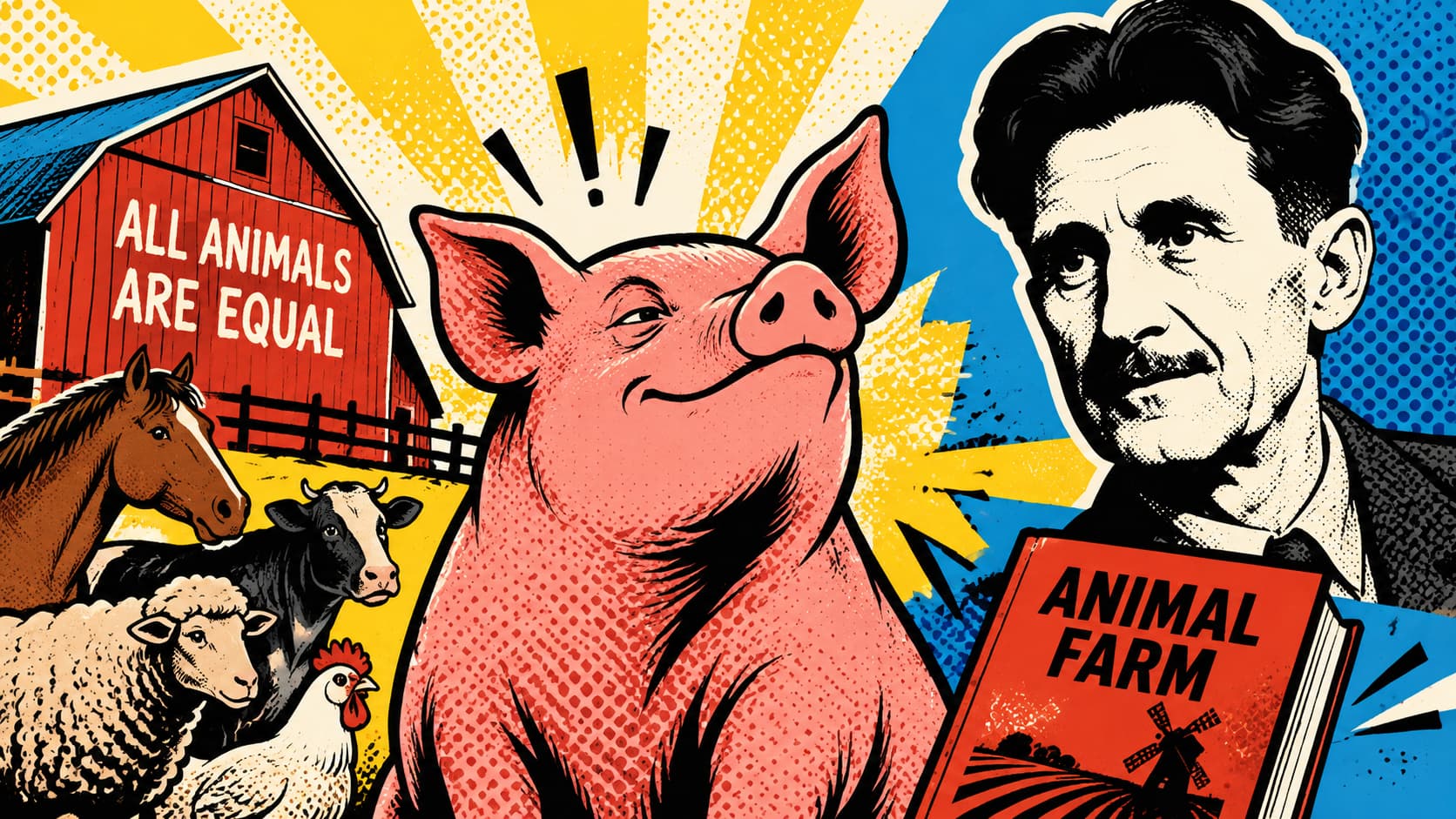
Well, I hope you skip the introduction. No? Then I’m grateful. It took me four straight hours with some breaks to finish reading Animal Farm, the famous allegorical satire by George Orwell (aka Eric Arthur Blair), written in 1945 (Ow! It was the Josef Stalin era; when the communist regime in Russia just started to darken deep).
A bunch of animal of the Manor Farm somehow manage to make a revolution. They repulse their owner, Mr. Jones, from the farm and take control over it. Then, what happened? That’s what the fable is all about.
When the downtrodden animals realize that they are under oppression by humankind, someone needs (here, allegorically, pigs are chosen to lead and do brainwork) to understand it and let this grasp spread among the others; the idea of revolution ignites. But the history of the world teaches us that power corrupts everything. It was never related to the welfare, but rather to tormenting the helpless and miserable.
Animal Farm depicts a society that is built on the faith of equality. Four legs good, two legs enemy. That was the motto. But equality cannot be sustained. Pigs are taking all the advantages, and dogs are securing their physical harm like some weapon. This peculiar society has grown up by the labor of other animals, but they never get any benefit from it. Whenever they raise any questions, or a few of them try to frown, pigs make an explanation and say, “Don’t you enjoy the freedom, comrades? Do you want Mr. Jones to take it back again?”
The dream of freedom seems more important than the real freedom; that’s what the animals try to believe or are forced to do. The animals work harder than ever, get less food, and benefit from ever less, and have a leader of their kind who makes them suffer, but they never understand it because of intellectual lack and clever manipulation from the pigs.
Orwell himself explains that he wanted to make a satire on the Stalinist era of the soviet union. He was a democratic socialist and a fan of the Russian Revolution of 1917. But his experiences of the Spanish Civil War in 1935 (don’t forget to read Homage to Catalonia) gave him insight into the terror that Francisco Franco’s fascism brought. And the motherland of socialism, Russia, suffered a personality cult established by Joseph Stalin that was nothing less than a brutal dictatorship. Though Stalin made Russia an overnight success in industrial progression, this also put a fatal decrease on food production; millions of Soviet people died in the winter of 1932–33 (which now we called as Soviet famine); the labor camp and gulag system cut out the possibility of a peaceful sleep from the masses. It’s quite clear that, while reading the novella, the old major who transmits the dream of revolution and died some months later is interpreted as Vladimir Lenin. And the leader pig Napoleon is a metaphor for Josef Stalin.
You can’t find a bit of non-linearity in the story arc. Maybe there’s no need to have any. But if you start to read it, through the activities, conversations, and occurrences the animals went through, you get into the very heart of it. By the time the book was published, the endless days and nights of world war two just on the verge of an end. But the labor camps were still the same in Soviet Russia; people of every class were suffering there. And the world has the right to get some light or darkness of it! Orwell just did the thing for us.
In our time, Animal Farm still matters. Because it sets an explanation for John Dalberg-Acton’s famous quote, “Power tends to corrupt, and absolute power corrupts absolutely.” Even a system that is built by the blood of millions of innocents cannot prevail over “the power,” the real evil.
Well, no more serious chit-chat. I think you may understand my feelings towards the book. Its dark ending left my heart with severe pain. As we see, our beloved world never gets rid of the immense mischief that we tend to do to our own kind.

Leave a Reply